Thursday, January 31, 2008

One-Make Races


For years in Asia and Europe, some automakers have held one-make races in which everyone uses the same vehicle to compete in a road race. It would be the equivilant of the Sports Car Club of America's (SCCA) spec Miata Class.

There have been a variety of one-make races throught the years, but some of my favorite one-make races are Toyota's Yaris Cup (Europe), Vitz Cup (Now called the Netz Japan, as Netz is a Toyota sub brand there), and Vios Cup (Thailand) races. Here we have a venerable (and affordable) Toyota subcompact racing against, well, a slew of other Toyota subcompacts – all of the same model (in this case, the Yaris, Vitz, or Vios). Very cool. While the Yaris and Vitz cups use the hatchback versions of these vehiles, Thailand's Vios Cup uses the Vios sedean (see below), know as the Yaris sedan in the U.S.

Theres a bunch of photos and vids if you go to Google.com and search for "Yaris Cup," "Vitz Cup," or "Netz Cup."

If you can read Japanese, this is great. If you can't it's still fun to poke around.

LINK: Netz Cup Japan

Monday, January 28, 2008

Yay Smaller Engines


I just read an article on Autoblog.com that General Motors will be bringing over a 1.4-liter turbo engine for the Saturn Astra. Good for GM.

I'm glad to see that GM is going to bring in a tiny powerplant. It's still a misconception that small engines can't keep up in traffic in the U.S. They may not be rocket ships, but they get along just fine. And, with forced induction (e.g. turbocharging/supercharging), these powerplants can be downright fun to drive and still get good mileage.

It wasn't too long ago that there were some pretty tiny engines on the U.S. market; 1.0-liter (Suzuki Swift/Geo Metro), 1.2-liter (Subaru Justy), and 1.3 liter (Suzuki Swift, Samurai, Geo Metro) to name a few. These cars from the 1980s got pretty good good mileages. Heck, the 1985 Chevy Sprint (made by Suzuki) got 39 city, 47 highway 23 years ago! (source: Fueleconomy.gov Granted, these cars weighed less due to fewer safety features and less sound insulation. Yes, they were slow, but I thought they were still fun to drive. Then again, "fun" means different things to different people. I happened to find my 1979 Civic 1200 fun, too – and it even had an automatic transmission. (I'll get into that in another post.)

Regardless, I'm glad to see GM bringing over some of its smaller engines, because using less fuel is a good thing. I hope to see some of the other manufacturers do the same.

Thursday, January 24, 2008

Suzuki Cars in th U.S.


I've been a fan of Suzuki vehicles for years. It all started with the Samuari, actually. Growing up in the 1980s, I thought it'd be cool to have a small off-road vehicle with a convertible top. Then it was the Swift GT. This car, which looked like a Geo Metro (because it was), had the 1.3 liter 100 hp engine. Small, quick, and fun. As many know, Suzuki's reputation was tarnished when Consumer Reports said the Samuari was prone to rollovers. And to this day, many people that aren't familiar with Suzukis still think of the Samurai, which is unfortunate, because the company makes a lot of good cars.

However, the U.S. has been short changed on most Suzukis, as many of the nameplates in the U.S. are actually Korean-made GM/Daewoo vehicles with an "S" badge slapped on. It's not that these are bad cars, but they aren't the interestingly designed Japanese- or European-market versions.


Sans the Aerio, Eesteem, and old Swift, the U.S. doesn't get many real Suzuki cars (e.g. Suzukis made by, well, Suzuki), unlike the rest of the World. Cars such as the funky Lapin (pictured at right), or Wagon R, or even new critically acclaimed new Swift. However, we do get the SX4, a new subcompact "crossover" based on the Swift chassis, but with all-wheel drive.


When the SX4 came out, I was pleased. I liked the looks, the performance, and the price wasn't bad, either. I've driven the SX4 (pictured at left) on a couple of occations, and find it drives very nicely. You can keep it in front-wheel drive for better fuel economy, or put it in all-wheel drive, and you can get it in a manual transmission! Heck, I wouldn't mind adding one of these to the garage in the future.

I've been noticing these vehicles more and more on the streets, and I like them more and more.

It's good to see Suzuki bring over a real Suzuki for a change, and a good one at that. Rumor has it that the new Swift will indeed be in the U.S. for 2010. I'll keep my fingers crossed. The SX4 is a good starting point, and I'm seeing more and more of them on the road. Even Costco had one in the store! Hopefully the SX4 is successful enough to show American Suzuki that their cars are appreciated in the U.S., and the whole Consumer Reports stigma of the old Samurais rolling over is a thing of the past.

Wednesday, January 23, 2008

A two door Mazda 2, too


If I was going to write a letter to Mazda, it'd go something like this.

Dear Mazda,

Please send over the Mazda 2 two-door to the U.S.

Thanks,

Andy


I think this is probably one of the best looking two-door hatchbacks as of late. Not sure why Ford seems to be shunning the subcompact genre in the U.S., but between this and the Fiesta, they've already got two of the best looking subcompacts on the market.

Think Big. Drive Small.


Small cars – I know them and love them! I even drive them. I don't have anything against other vehicles; I just find myself drawn to small cars. And with the recent increase in fuel costs, small cars are big.

Aside from getting good gas milage, they're surprisingly fun to drive and are funky to look at. These mighty mights are often small on the outside but big on the inside. They're usually more entertaining to drive than one might think. They're nimble and zippy, whether it's being able to easily fit into a parking spot downtown, or if it's out for a sprint on an autocross course – small cars are fun. They take up less space, and use less fuel, which is great for a number of reasons.

Subcompact cars (or b-segment cars, micro cars) are finally gaining some popularity in the U.S. They've been "big" all over the world for years. We even had a plethora of sub-compacts in the U.S. during the 1980s.

Remember when "small cars" were actually small?

Remember when a Honda Civic was tiny? The newer Civics are now the size the Accords used to be.

Remember cars like the Subaru Justy, the Suzuki Swift, Chevy Sprint, or the earlier Mitsubishi Mirage? Many would probably rather not remember these. Yes, they were crude, but they were great on mileage, easy to park, and fun to drive.

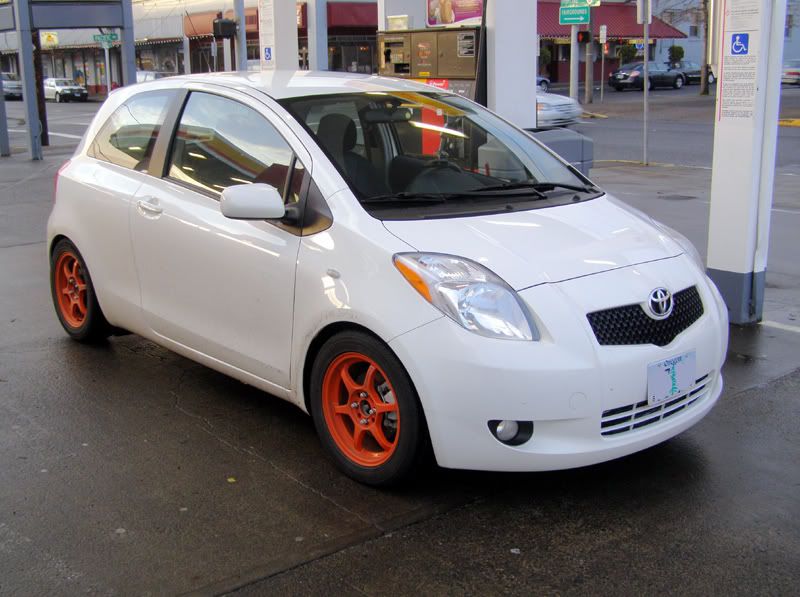
Well, the second coming of small cars are upon us in the U.S. While the rest of the world has been enjoying the Toyota Yaris/Vitz, Honda Fit/Jazz, Suzuki Swifts, and other vehicles, we're just starting to get these vehicles in the U.S. again – and I love it. It's great to have the option to buy a genuine small vehicle again. If there's been one benefit to the increase in gas costs over the last few years, to me it's been the availability of small cars again. I don't need a large vehicle; I don't tow anything. So a small car works perfectly. My little Yaris pictured above hatchback can swollow quite a bit of cargo; not as much as my old xB, but a good amount nonetheless. Plus, it's a blast to drive thanks to the upgraded suspension system and wheels and tires. It's like a large, white go kart.

When it comes to cars, I tend to think big (as in big fuel savings, big cargo capacity for a small vehicle, and big fun), but buy small (as in small costs, small gas bill, small size).

Think big. Drive small. Get it?


So what is a subcompact car?

So what makes a car a subcompact, supermini, or B-segment? Generally speaking, most subcompact cars have a wheelbase under 100 inches, although some newer subcompacts do have slightly longer wheelbases. So what cars are considred b-segments, superminis, or subcompacts in the U.S.?

Chevrolet Aveo
Honda Fit
Hyundai Accent
Kia Rio and Rio 5
Mini Cooper
Nissan Versa
Scion xA
Scion xB (2004-2006)
Suzuki SX4
Toyota Yaris

Size and weight wise, most of these vehicles fall below the company's "compact" offerings. For instance, the Chevy Aveo is smaller than the Chevy Cobalt. The Honda Fit is smaller than a Honda Civic. The Toyota Yaris is smaller than a Toyota Corolla and so on.

Just about every automaker in Europe and Asia offers a subcompact vehicle, and there's been recent talks about importing other B-segments entering the market from Volkswagen, Chrysler, Mazda, Ford, and more.